Finding the right 100A MPPT solar charge controller can maximize energy harvest, extend battery life, and protect your off-grid or RV solar setup. This guide highlights five top options that fit 12V, 24V, 36V, and 48V systems, with features like high tracking efficiency, parallel expansion, battery protection, and intuitive displays. Each model is evaluated for versatility, reliability, and user-friendly configuration to help you compare performance without the guesswork.
Summary of Selected Products
| Brand | Model / Key Note | Voltage Compatibility | Parallel Capability | |
|---|---|---|---|---|
| POWLAND | 100A MPPT Solar Charge Controller | 12V/24V/36V/48V | Yes (via standard design for expansion context) | 4-level charging algorithm with high efficiency |
| Depvko | 100A MPPT Solar Charge Controller, with USB & LCD | 12V/24V | No explicit parallel claim | LCD display for status and configuration |
| PowMr | PowMr 100A MPPT Solar Charge Controller | 12V/24V/36V/48V | Supports up to 12 units in parallel | Parallel expansion capability |
| Renogy | Renogy 100A MPPT Solar Charge Controller | 12V/24V/36V/48V | Supports multi-voltage systems with auto-detect | High MPPT efficiency and protective features |
| HQST | HQST 100A MPPT Solar Charge Controller | 12V/24V/36V/48V | Not explicitly stated | Bluetooth app control and low-temp protection |
Overview notes: The listed models cover a spectrum of features—from strong MPPT efficiency and battery protection to parallel expansion and remote monitoring. When selecting, consider the battery chemistry you use (lead-acid versus LiFePO4), the maximum system voltage, and whether you need remote monitoring or a display on the unit itself. The following sections dive into detailed per-product profiles to aid your decision.
POWLAND 100A MPPT Solar Charge Controller

The POWLAND model is a versatile 100A MPPT charge controller designed for mixed-voltage systems. It supports 12V/24V/36V/48V battery configurations and includes a four-stage charging sequence (bulk, boost, float, and equalize) aimed at efficient, safe charging and longer battery life. Its MPPT algorithm emphasizes rapid maximum power point tracking and a high solar utilization rate, with claimed efficiencies near 98% and above. Protection features include short circuit, open circuit, reverse, and overload protections. This unit is well suited to solar RVs and small to mid-size home solar setups where robust protection and adaptability matter.
Pros: High charging current capability, comprehensive protection, broad voltage compatibility, strong MPPT tracking. Cons: Some users may want more explicit parallel expansion documentation.
Depvko 100A MPPT Solar Charge Controller

Depvko offers a 100A MPPT controller with automatic 12V/24V adaptation and an easy-to-read LCD display showing status and data. It emphasizes a plug-and-play approach: connect the battery first, then the solar panels. The model highlights a protective regime designed to prevent lithium battery over-discharge, suitable for residential use, small businesses, and industrial applications. Its emphasis on display readability makes tuning and monitoring straightforward for users who prefer on-device data over app-based monitoring.
Pros: User-friendly LCD display, auto-detects system voltage, practical protection for lithium. Cons: Fewer explicit notes on parallel expansion.
PowMr 100A MPPT Solar Charge Controller

PowMr’s model emphasizes scalability with parallel operation—up to 12 units in parallel. It supports 12V/24V/36V/48V systems, making it a strong choice for expanding solar arrays. The controller applies a three-stage charging approach (Bulk, Boost, Float) and includes an adaptive boost function to reduce charging duration while extending battery life. Its parallel capability makes it appealing for larger RVs, boats, or small commercial installations that plan to scale energy storage.
Pros: Strong parallel expansion, robust charging stages, broad voltage support. Cons: Parallel setups may require careful system design to ensure balance across units.
Renogy 100A MPPT Solar Charge Controller

Renogy’s 100A MPPT controller is designed to work with 12V/24V/36V/48V systems and supports a wide range of battery chemistries, including lead-acid and lithium variants. It includes advanced MPPT technology with high efficiency, external sensor options, and self-diagnostic features. Its IP32-rated housing and protective provisions make it a solid candidate for RVs, marine use, and off-grid installations, especially where weather and temperature variations are common. The controller is designed to maximize energy harvest and protect the battery through temperature-compensated charging and safe operational thresholds.
Pros: High MPPT efficiency, broad battery compatibility, rugged protection. Cons: Some users may want more explicit Bluetooth/app integration depending on use case.
HQST 100A MPPT Solar Charge Controller
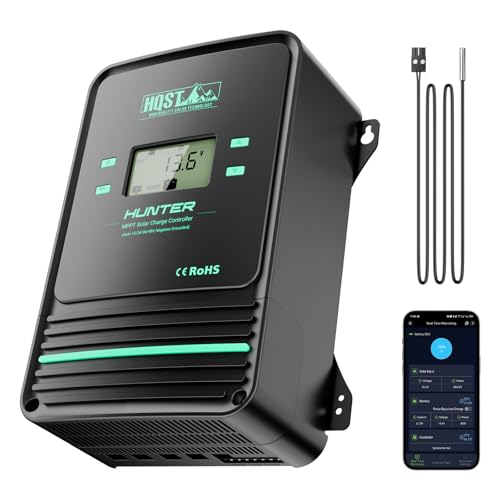
HQST delivers a 100A MPPT controller with Bluetooth app control and an LCD panel for local monitoring. It supports LiFePO4 as well as sealed, AGM, GEL, and flooded batteries, making it a flexible choice for diverse battery chemistries. The controller’s high-efficiency MPPT tracking (up to 99%) and a strong temperature range help optimize solar harvest across seasons. The device also includes a low-temperature cut-off to protect LiFePO4 cells in cold environments, which is particularly relevant for winter camping and northern installations.
Pros: App-based monitoring, broad battery compatibility, cold-weather protection. Cons: Bluetooth range is limited to around 10 meters in typical environments.
OOYCYOO MPPT Charge Controller 100A

OOYCYOO offers a 100A MPPT controller with auto-identification for 12V/24V systems and a max PV input power specification designed to accommodate lead-acid and LiFePO4 batteries. The device is positioned for straightforward installation and general-purpose solar setups. It emphasizes compatible battery types and a robust open-circuit voltage range, which can help ensure safe operation with different solar panel configurations. This model aims to balance ease of use with reliable MPPT performance for residential or light commercial use.
Pros: Auto voltage detection, broad compatibility, straightforward operation. Cons: User reviews may vary on long-term durability; parallel expansion details are less explicit.
Temank 100A MPPT Solar Charge Controller

Temank provides a 100A MPPT controller with the option to connect up to 12 units in parallel, enabling large-scale solar installations. It uses a die-cast aluminum chassis with a turbofan cooling system to manage heat, which can improve reliability in hot environments or prolonged operation. The controller supports 12/24/36/48V operations and is compatible with lead-acid and lithium batteries, with user-programmable absorption, float voltages, and low voltage cutoffs. The design focuses on modular expansion and robust performance for RVs, commercial vehicles, and boats.
Pros: Strong parallel capability, effective cooling, broad battery support. Cons: Parallel operation may require thoughtful wiring and system balance across units.
Buying Guide: Key Purchase Considerations
- System voltage and battery chemistry: Ensure the controller auto-detects 12V/24V/36V/48V and supports your battery type (lead-acid, LiFePO4, AGM, etc.).
- MPPT tracking efficiency: Higher efficiency values (often above 98–99%) maximize energy harvest, especially under variable sunlight.
- Parallel expansion: If you plan to scale up solar capacity, verify whether the model supports paralleling multiple controllers (and how many) without compromising safety or performance.
- Safety protections: Look for protections against short circuits, reverse polarity, overcurrent, overvoltage, deep discharge, and temperature to safeguard both panels and batteries.
- Display and monitoring: Decide between on-device LCD/LED displays, Bluetooth/app monitoring, or both. Apps offer remote monitoring, while an LCD helps in environments without reliable connectivity.
- Operating temperature and low-temperature cut-off: Cold-weather operation matters for LiFePO4 and outdoor installations; confirm protective features match your climate.
- Physical build and cooling: Die-cast housings and built-in cooling (fan-assisted) help sustain performance in hot or enclosed spaces such as RV compartments.
- Maintenance and diagnostics: Self-diagnostics and voltage compensation features reduce risk of battery damage and simplify setup.
When selecting, align the controller’s capabilities with your specific goals—whether you’re outfitting a small off-grid cabin, an RV, a boat, or a larger solar array. Consider future expansion plans and ensure the wiring and fusing are designed to handle higher currents when paralleling units. Cross-check warranty terms and available support resources from the brand to protect your investment over time.